EVCI.tech · Cape Town · EV Charging Reality Check
Living with
Level 1 Charging
People seriously over-complicate home EV charging — especially with PHEVs. Your portable charger is probably all you need. Here’s the maths to prove it.
Let’s be honest
Do You Actually Need a Wallbox?
There’s a whole industry built around convincing you that you need the fastest possible charger at home. And for some people — sure, a 7 kW wallbox makes sense. But the honest truth is that most EV and PHEV owners, most of the time, don’t actually need one. Especially PHEV owners, whose batteries are often 18–30 kWh — a portable charger handles that easily overnight.
Yes, Level 1 is slow. Slower than a wallbox. But here’s the thing nobody mentions: you’re charging while you sleep. You don’t experience the slowness. Your car doesn’t care. And the electricity cost is identical — because you pay for kilowatt-hours, not speed.
Level 1 can also be an ideal starter
for Airbnb and Guesthouse Hosts
Know your charger
Level 1, 2 & 3 — What’s the Difference?
1.8 – 3.6 kW
Level 1 — Portable Charger
The charger that came in the box with your car. Plugs into a standard 16A socket or dedicated outlet. Completely underrated. Works perfectly for overnight charging.
18 kWh PHEV battery: 5–10 hours
7 – 11 kW
Level 2 — Home Wallbox
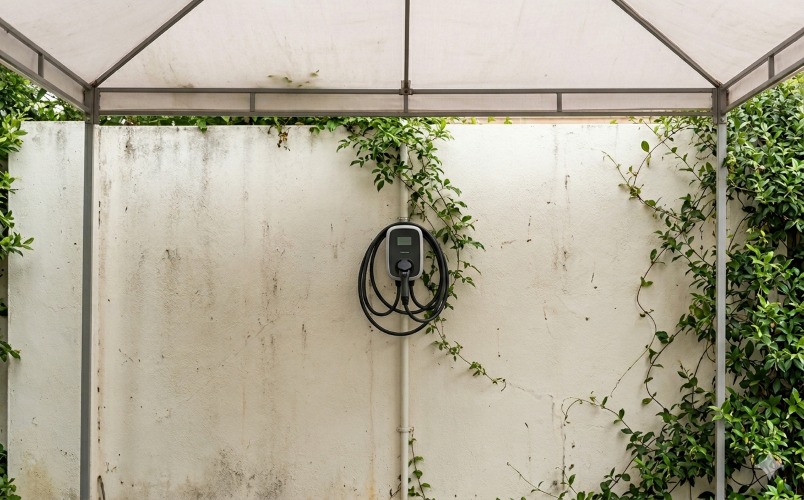
Dedicated installed unit. Faster charging — great if you drive long distances daily or have a big battery. Requires a licensed electrician and CoC. Same cost per kWh.
18 kWh PHEV battery: 2–3 hours
50 – 150+ kW
Level 3 — DC Fast Charger
Public rapid chargers (GridCars, Rubicon, etc.) for long trips. 30–80% in 20–40 minutes. Not for home use. More expensive per kWh than home electricity.
Used for: Road trips, top-ups on the go
Portable Charger Plugged In Overnight

Show me the numbers
The 5-Day Real-World Test
Let’s run this properly. A 40 kWh battery, starting at 60% on Monday morning. You drive 100 km every day (typical Cape Town commute and errands). You plug in your 2.3 kW portable charger when you get home and unplug when you leave — 10 hours overnight. That’s it. No wallbox. No planning. Just plug in and sleep.
Your car uses roughly 16.7 kWh per 100 km (typical for a modern EV at 6 km/kWh). Your charger adds 23 kWh per night. Here’s what actually happens:
| Day | Start | After 100 km | Charged overnight (+23 kWh) | End of day |
|---|---|---|---|---|
| Monday |
60% (24.0 kWh)
|
18% 7.3 kWh left | +23.0 kWh added |
76% (30.3 kWh)
|
| Tuesday |
76%
|
34% 13.7 kWh left | +23.0 kWh added |
92%
|
| Wednesday |
92%
|
50% 20.0 kWh left | +20.0 kWh added (battery full) |
100% ✓
|
| Thursday |
100%
|
58% 23.3 kWh left | +16.7 kWh added (battery full) |
100% ✓
|
| Friday |
100%
|
58% 23.3 kWh left | +16.7 kWh added (battery full) |
100% ✓
|
The money question
What Does It Actually Cost?
Here’s the part that surprises most people. Charging speed has absolutely no effect on what you pay. You buy electricity in kilowatt-hours — not hours. Whether you add 23 kWh in 10 hours (portable) or 23 kWh in 3.3 hours (7 kW wallbox), the electricity cost is identical: 23 kWh × R3.50 = R80.50. The wallbox just gets there faster.
⏱ 2.3 kW Portable Charger
Takes 10 hours to add 23 kWh.
Cost: R80.50
You are asleep for all 10 hours.
You notice: nothing.
⚡ 7 kW Wallbox
Takes 3.3 hours to add 23 kWh.
Cost: R80.50
You are asleep for 3.3 hours of it.
You notice: nothing.
Charge time reference
How Long Does Each Charger Take?
| Charger type | Speed | 40 kWh EV (0→100%) | 18 kWh PHEV (0→100%) | Cost per 20 kWh added |
|---|---|---|---|---|
| Portable — brick (standard) | 1.8 kW | 22h 13m | 10h 00m | R70 |
| Portable — standard 16A | 2.3 kW | 17h 23m | 7h 49m | R70 |
| Fast portable / 16A dedicated | 3.6 kW | 11h 06m | 5h 00m | R70 |
| 7 kW wallbox | 7 kW | 5h 42m | 2h 34m | R70 |
| 11 kW wallbox (3-phase) | 11 kW | 3h 38m | 1h 38m | R70 |
Highlighted rows = Level 1 portable charger range · Cost per 20 kWh at R3.50/kWh — identical regardless of charger speed · Times are theoretical 0→100%, real-world varies with temperature and charge curve
Let’s kill the myths
Common Misconceptions — Debunked
When a wallbox makes sense
Start Level 1. Upgrade When It Makes Sense.
Level 1 is not a compromise — it’s the right starting point for most people. But there are real situations where a wallbox is genuinely worth it. The smart approach is to start with a dedicated 16A socket, and upgrade the circuit to a wallbox later without any rework.
Dedicated 16A Socket
R2,500–R4,000 installed. Safe, compliant, CoC-issued. Handles any portable charger. Spec’d for wallbox upgrade later — no rework needed. Perfect for most PHEV owners and moderate EV commuters indefinitely.
7 kW Wallbox
Bolt the wallbox onto the existing circuit when demand grows. Cable, conduit, DB work, earthing all already done. You’re paying only for the charger unit and commissioning. Makes sense if you drive 150+ km daily or need faster turnaround.
Wallbox Upgrade — Same Socket Position