EVCI.tech · Cape Town · Updated 2026
EV Charging in
Apartment Blocks & Sectional Title Schemes
The honest, no-corporate-fluff guide to what’s actually happening — and not happening — with EV charging in South African sectional title schemes in 2026. Written by an electrician in the EV space who deals with this frustration every single week.
How the rest of the world handles this
Global Lessons — None of Which Apply Here
Every country that’s actually serious about EV adoption has passed legislation protecting apartment residents’ right to charge. South Africa has done none of this. Let’s be clear about exactly what we’re missing.
California, USA
Right to Charge ✓HOAs cannot unreasonably block EV charger installations. They need a valid technical reason to say no — not just discomfort or resistance. Residents can legally force the issue.
Norway
Mandatory Access ✓Legislation requires buildings to accommodate charging requests. Government-backed grants cover infrastructure. Result: over 80% EV adoption. That’s what policy leadership looks like.
Québec, Canada
Right to Charge ✓Condo boards must accommodate EV charging requests unless technically impossible. “We don’t want to” is not a valid reason. The burden of proof is on the board to refuse.
South Africa
No Law — Nothing ✗No right to charge. No mandatory access. No government grants. No EV infrastructure policy for apartments. Everything falls back on internal scheme governance — and the willingness of your specific trustees. That’s it.
Government is actively holding back adoption
This isn’t a neutral observation — the absence of “right to charge” legislation in South Africa is a policy failure. Every week, EV owners in apartments are blocked, delayed, or simply worn down by trustee resistance that would be illegal in any serious EV market. Government has had years to address this. They haven’t. In the meantime, individual owners pay the price — in time, legal fees, and the indignity of having to beg for permission to charge a car they legally own.
The SA legal framework
What Actually Governs This — The STSMA
In the absence of specific EV legislation, everything is governed by the Sectional Titles Schemes Management Act (STSMA). Here’s what that actually means in practice — stripped of the legal jargon.
The Legal Reality — STSMA 2026
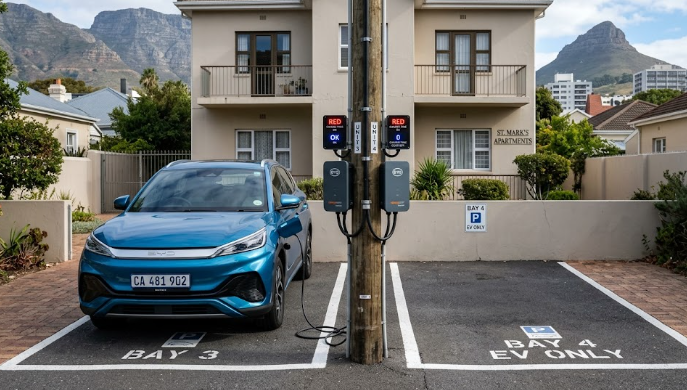
Cape Town Apartment Block / Sectional Title Complex
For trustees who actually want to get this right
The Practical Roadmap — Step by Step
Don’t wait for a dispute to land on your desk before thinking about EV charging. By then you’re already in reactive mode, and the owner making the request is already annoyed. Here’s how to get ahead of it — properly.
First
Commission a Proper Load Assessment
Before anything else — find out if your building can actually carry the load. This sounds obvious. Surprisingly few bodies corporate do it proactively. A qualified electrician (ideally one with EV experience — not just the guy who replaced a plug last year) assesses your building’s main incomer capacity, existing demand, and headroom for EV circuits.
Most modern apartment buildings can accommodate EV charging — especially with smart load balancing. But you need the numbers, not assumptions. A load assessment also protects trustees legally: you can’t be accused of refusing without a technical basis if you have a report in hand.
- Commission from a registered electrician — get it in writing with calculations
- Determine available capacity on main incomer and distribution boards
- Assess parking layout — which bays can realistically be served by a cable run
- If capacity is limited — smart load balancing chargers can work within existing infrastructure
Second — and most important
Draft a Charging Policy Before Any Dispute Arises
This is the single most important thing trustees can do. A policy drafted before the first request arrives is a governance document. A policy drafted in response to a specific owner’s request looks like targeted obstruction — and creates CSOS exposure.
Your policy should cover the essentials without being a 40-page legal nightmare:
- Installation standards — SANS 10142-1 compliance required, CoC mandatory, registered electrician only
- Sub-metering requirement — every charging point must have its own meter. Non-EV owners must never subsidise EV charging through general levies
- Liability — owner indemnifies the body corporate. The BC is not responsible for your car or your charger
- Cable routing — must be pre-approved, must use conduit, must not damage common property permanently without consent
- Application process — formal written request, technical drawings, approval required before any work starts
- Future-proofing clause — policy should allow the board to revisit standards as EV adoption grows
Third
Pass the Policy at AGM — Get It on Record
Trustee resolutions are fine for day-to-day decisions, but an EV charging policy that affects all owners should go through the AGM. Full stop. A policy that owners have voted on is essentially bulletproof against CSOS complaints about inconsistent treatment. A trustee resolution passed in a closed meeting — without notifying all owners — is not.
Under the STSMA, proposed rule changes require at least 30 days written notice to all members before the meeting where the vote takes place. Get your agenda out early.
Fourth
Use Smart Technology — Don’t Rely on Trust
The biggest fear non-EV owners have — and it’s a legitimate one — is that they’ll end up subsidising your electricity through levies. The fix is technology, not goodwill. Smart chargers with RFID cards, app-based authentication, or PIN access ensure that only the registered user can activate the charger, and that usage is billed directly to that user.
Modern chargers can also communicate with the building’s main DB — load balancing means the charger automatically throttles its speed during peak hours to prevent tripping the building’s main breaker. No more arguments about “your car trips the power at 2am.”
- RFID or app authentication — only registered users can start a charge session
- Individual sub-metering — consumption logged per user, billed separately. No levy cross-subsidy
- Dynamic load balancing — charger talks to the building DB, adjusts draw to prevent overloading
- Remote management — managing agent or trustee can disable, monitor, or report on any charger remotely
Fifth — explore this
Consider Private Infrastructure Providers
Financing models are emerging in South Africa where private providers install the entire backbone infrastructure — cabling, distribution boards, smart metering, charger units — at zero cost to the body corporate. They recover costs through a user-pay model (either a per-kWh fee or monthly subscription from EV-owning residents).
For schemes where the body corporate has no appetite for capital expenditure — and most don’t — this is often the path of least resistance. The BC gets EV infrastructure, zero upfront cost, and a revenue-neutral (or even slightly positive) outcome.
The honest trade-offs
Challenges — Not Solved by Wishful Thinking
Cost Perception
Non-EV owners fear levy increases or hidden subsidies. This fear is valid and won’t go away with reassurances. Only hard-wired sub-metering and transparent billing actually fixes it. Words don’t.
Fire Safety Anxiety
EV fires make headlines. Statistically they’re rare — ICE cars burn far more often. But the fear is real. Every installation must have a CoC. Every charger must be Type A RCD-protected. Don’t argue feelings; just do the paperwork correctly.
Load Overload Risk
Six residents plugging in 7 kW chargers simultaneously at 6pm will trip most buildings. The fix is dynamic load balancing — not refusing EV charging. Technology exists. It just needs to be spec’d correctly from the start.
Trustee Inertia
Many trustees genuinely don’t understand EVs, don’t own one, and don’t see it as urgent. They’re not malicious — they’re just not incentivised to move fast. Formal requests with technical documentation get responses faster than verbal conversations.
Government Absence
No “right to charge” law. No grants. No guidance. No urgency. While the rest of the world legislates EV infrastructure into apartments, South African government publishes discussion documents and holds workshops. Meanwhile, owners wait.
CSOS as Last Resort
If trustees refuse without technical basis, you can take it to CSOS. It’s slow and frustrating — but it exists. Document everything: your request, their response, the dates. A paper trail is everything if this escalates.
Smart EV Charger in Apartment Parking
Bottom line
What Actually Works in 2026
Stop waiting for government to fix this. They won’t — not anytime soon. The pathway forward in Cape Town and across South Africa is proactive private governance: trustees who draft policies before disputes land, load assessments done on the front foot, and smart technology that makes the billing transparent enough that non-EV owners have nothing to complain about.
If you’re an EV owner in a sectional title scheme: document everything, propose a scheme-wide policy rather than an individual request, and find an electrician who understands both the technical and governance side of this — because most don’t.