EV and PHEV Charging Installer, Licensed Electrician, Cape Town
Cape Town Installer · Licensed Electrician
So you’re getting an EV.
Let’s talk about the wall box.
I’m Frankie. I install EV chargers in Cape Town — properly. That’s all I do. Here’s everything you need to know before you spend a cent.
WhatsApp Me →Free Site Visit – Full Assessment First.
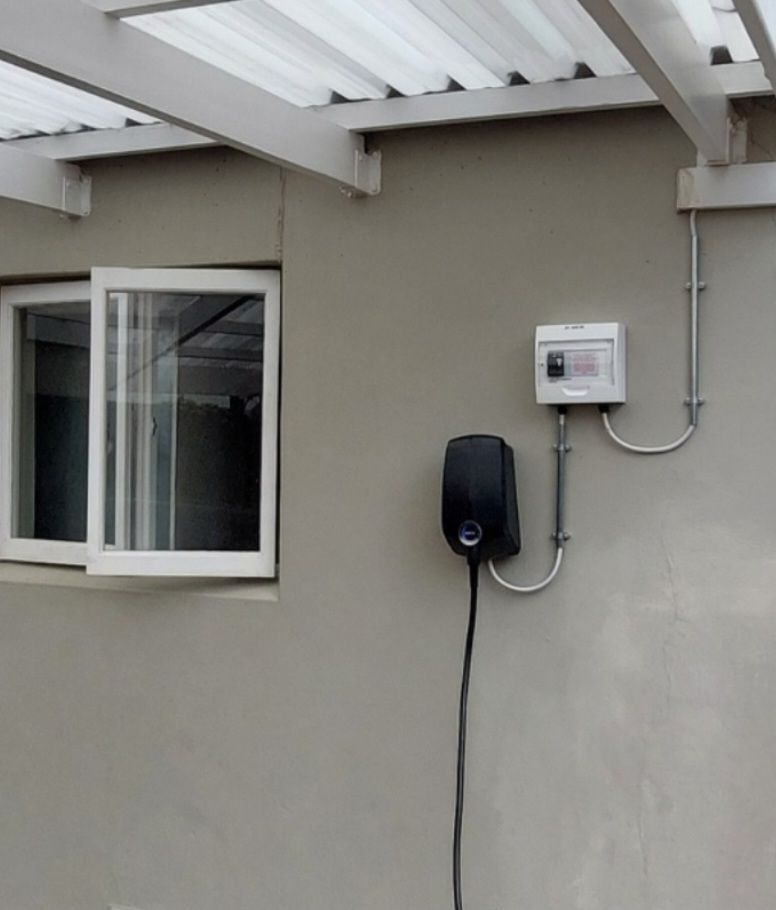
1 — The short version
One electrician. One job at the time.
I install home and business EV chargers — and nothing else. My name is on every job.
Most electricians can mount a wall box. Not all of them will tell you when your DB board isn’t ready for one — or when that portable unit from the dealership is quietly overloading your kitchen circuit at 16 amps, every single night.
Before I touch a single cable, I assess your electrical capacity, the position of your DB board, and how your charger needs to be configured.
In other words, I come to you, assess your supply, and give you a straight answer in writing – No obligation.
WhatsApp Me →Free Site Visit – Full Assessment First.
2 — The power question
Will my existing power cope with a new charger?
Most Cape Town homes run on a 60 amp, single-phase supply. That’s the total capacity available to everything in your house at once — lights, appliances, geyser, everything. Add an EV charger and the competition for those 60 amps gets serious.
Your real starting point — before any scenarios
A 7kW (single-phase) EV charger draws roughly +30 amps on its own. If anything significant switches on while it’s charging (like a kettle), you’ve got a problem — unless the system is managed.
What that looks like in real life
37A headroom − 15A (pool + washing) = 22A left for the charger, vs 30A the charger needs.
Fix: throttle the charger to 3.6kW (16A), or auto-pause an appliance until the charging is done.
37A headroom − 25A (stove + dryer) = only 12A left, vs 30A needed.
Fix: Avoid charging during peak cooking hour. Charge overnight instead — costs nothing to change the habit.
37A headroom − 11A (aircon) = 26A left, vs 30A needed.
Fix: throttle to ~5kW (22A) for a 4A safety margin, or hold the geyser during charge (two of many options).
The two real solutions
A sensor on your main incoming cable watches total household draw in real time. When it nears your limit, it automatically pauses non-essential appliances — then switches it back on when there’s room. Fully automatic, protects the whole house, works with any charger.
Some smart chargers can be dialled down, roughly halving the draw. (SANS 10142-1 focusses on wiring code – Dynamic throttling is handled by EVSE, not SANS) – Yes, charging takes twice as long, but for overnight charging that rarely matters. Downside: it only manages the charger, not the rest of the house.
3 — The wall box question
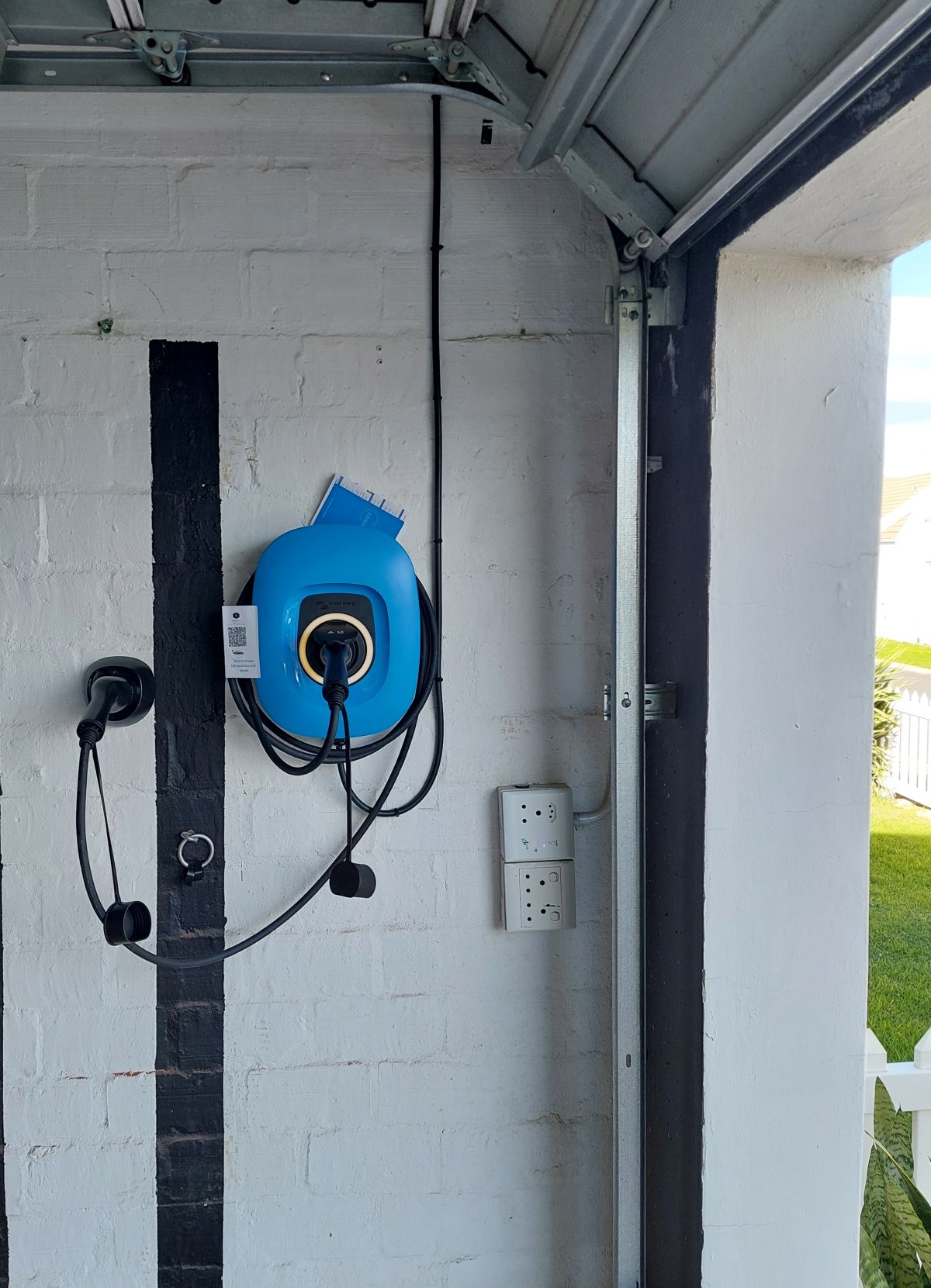
Do you actually need a wallbox? The PHEV charging dilemma.
There’s a whole industry built around convincing you that you need the fastest possible home charger. Truth is, many smaller electric vehicles – and especially PHEV owners don’t — a PHEV battery (18–30 kWh) charges easily overnight on the Portable Charger (level 1) that comes with the car.
The key insight: speed only matters if you’re in a hurry. You pay for kilowatt-hours, not hours. Charging at 2.7kW overnight costs exactly the same as charging at 7.4kW — it just takes longer, and you’re asleep either way.
A real 5-day test
40kWh battery, starting at 60%. 100km driven daily. Portable 2.7kW charger, plugged in for 10 hours overnight.
Here’s what actually happens:
Monday: 60% → 18% after the drive → 76% after charging.
Tuesday: 76% → 34% → 92%.
Wednesday: 92% → 50% → 100% (full).
Thursday & Friday: start the day at 100%, on a portable charger alone.
500km driven across the week, and the portable charger was never the bottleneck — you slept right through the charge.
What it actually costs
Speed costs nothing extra. The wallbox just gets there faster — it doesn’t get there cheaper.
Charge time reference
These are full 0→100% times. In practice most daily charging is a 30%→80% top-up — roughly half the numbers above, on any charger.
EV & PHEV Charging Myths
- “A wallbox charges cheaper.” False — you pay per kWh, not per hour.
- “PHEVs need a wallbox.” Most fill an 18kWh battery overnight on a portable charger regardless. A bigger wall box is a nice to have (not essential).
- “You have to charge to 100% nightly.” Most manufacturers recommend 80% for daily use anyway.
- “A wall socket is dangerous for this.” A dedicated, unfused 16A circuit is fine. A shared multi-plug or extension cord is the actual danger.
Start small. Upgrade when it makes sense.
R5,000+/- installed. Safe, compliant, CoC-issued. Spec’d for a wallbox upgrade later with zero rework. Fine indefinitely for most PHEV owners and moderate commuters.
Bolt it onto the existing circuit. Cable, conduit and DB work are already done — you’re only paying for the charger unit, type A ELU – and commissioning. Makes sense past 150km/day, a 60kWh+ battery, or two EVs sharing one point.
4 — The solar question
I’ve got solar. Does that mean free charging?
Almost entirely no — and it’s worth knowing why before you assume it.
An EV charger installer and a solar installer are two different trades. I wire and configure the charger.
Your solar installer designs the panels, inverter and battery, and decides how the battery behaves after dark.
Two trades, two breakers — they need to talk to each other, not be treated as one system.
A typical Cape Town solar home
Your solar battery won’t last long as a car charger
7kW charger + 10kWh battery: flat in 1.4 hours. ~52km of range — and your load-shedding backup is gone.
7kW charger + 15kWh battery: flat in 2.1 hours. ~79km of range, same problem.
Night charging from a home battery isn’t free — it’s borrowed capacity you paid R80,000–R150,000 for, meant to keep your fridge and router alive through load shedding, not fuel a car.
Daytime is where it genuinely works
A 5kW system at peak only covers part of a 7kW charger’s appetite — the gap comes from the grid. An 8kW+ system generating 7kW+ at noon can cover a full-speed charge with nothing left over.
Peak solar hours in Cape Town: roughly 10am–3pm.
- A smart, throttleable charger that tracks solar surplus automatically
- Charging during the day, not from the battery at night
- An inverter properly configured to route surplus to the charger first
- The charger drawing from generation directly — never routed through the battery
The honest line: daytime charging on a well-configured system can be genuinely free or near-free. Night charging from a solar battery is neither free nor kind to a battery you paid a lot for.
5 — The “can’t my guy do it” question
Can any electrician install a charger?
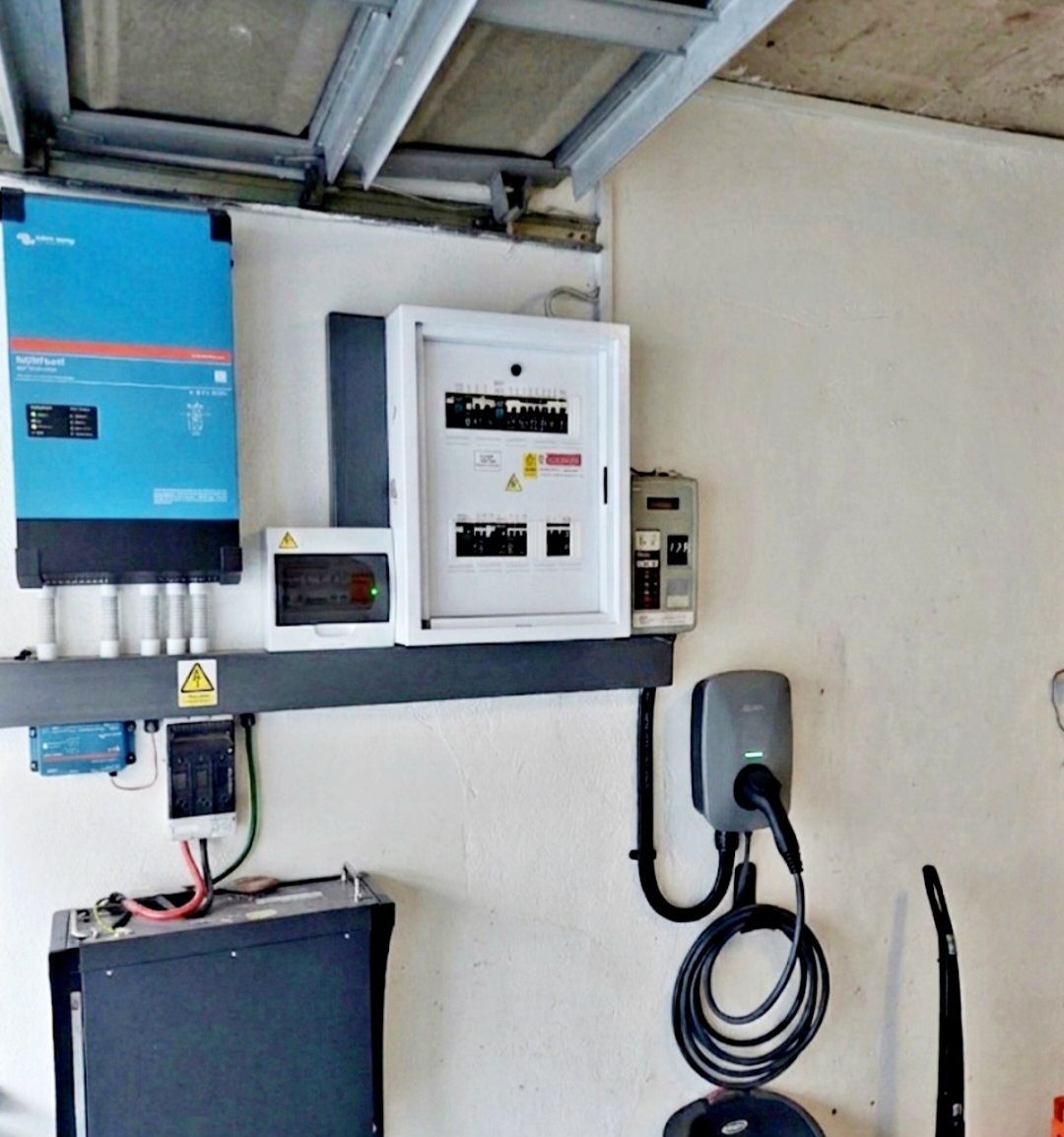
Legally, yes — any registered electrician can install a wallbox and issue a Certificate of Compliance. Practically, not every electrician has actually done one before, and this isn’t like wiring a plug point.
Here’s what a proper installation actually involves:
Charger vs. your car’s own limit
Check the vehicle’s on-board charger capacity first. Fit a premium 22kW three-phase unit to a car that only accepts 7.4kW single-phase, and the car’s computer simply ignores the extra power. Money spent, nothing gained.
The 60–80A reality
A standard 7.4kW charger draws 32A continuously. On a tight 60A supply with aircon, geyser and pool pump already running, an unmanaged 32A load trips the main breaker. This is exactly the load-balancing conversation from question 2.
Earth leakage — it’s not one-size-fits-all
Standard household earth leakage (Type AC) is blind to the DC fault currents an EV’s charging electronics can produce — and DC leakage can actually stop a Type AC breaker from tripping when it should. This needs a Type A RCD with DC fault sensing, or a dedicated Type B unit.
The 125% rule
Unlike a fridge that cycles on and off, a charger runs at maximum draw for hours — real thermal stress on the DB board. Protection has to be sized at 125% of the charger’s max current: a 32A charger needs a 40A breaker and a minimum 6mm² cable.
Earthing matters more than usual
Your car’s metal chassis becomes part of the earth loop. A poor connection can make the frame live — a real shock hazard, particularly for cars parked outdoors.
Type 2 surge protection
A Type 2 voltage surge protection device (SPD) on the circuit protects the charger’s electronics — and your car’s onboard charger — from lightning-induced and switching transients on the supply. Cape Town’s summer storms and load-shedding-related switching spikes make this a sensible add, not an optional extra, on a circuit feeding electronics as sensitive as an EV’s.
Registered, and on paper
This is a major modification to your home’s fixed electrical infrastructure. It must be done by a Department of Labour registered electrical contractor, finished with a formal Certificate of Compliance — RCD type and earth loop impedance included.
Ask whoever you’re considering how many EV chargers they’ve actually installed. This is the only work I do, which is a fairly direct answer to that question.
6 — The cost question
How much will a charger install actually cost?
Most EV and PHEV charging purchases include a free portable charger (many now come with a 7-22kW wallbox).
Installing it properly is a separate line item.
Cable run length is the single biggest swing factor in that installation price. A DB board 3 metres from the parking bay is a very different job to one 20 metres away with a wall, a driveway, or a floor to cross — that distance can move the quote by thousands, which is exactly why it’s measured on site, not guessed over the phone.
5 steps to a firm quote
- A site assessment is a prerequisite — you can’t sidestep this one.
- Quote to install the charger itself.
- Quote to mitigate power balancing, if your supply needs it.
- Check the electrician is registered with the Department of Labour.
- Ask if they’ve actually done this type of install before.
No two homes cost the same — board condition, cable run length, and parking distance all move the number. The written proposal after the site visit gets you real figures, not a range.
7 — The bill question
How much will my electricity bill go up?
You pay by the kilowatt-hour, not by the charger’s speed.
And realistically, you’re not charging from empty to full every night — most owners top up from around 30% to 80%, which is also what manufacturers recommend for daily battery health. That’s the number worth budgeting for, not a 0–100% figure you’ll rarely actually use.
That’s roughly R43,600 a year back in your pocket — on a charger that came free in the box with your car. Exact numbers depend on your battery size, your tariff, and how much you actually drive, which is exactly what a proper assessment gives you.
8 — The sectional title question
I own or rent in an apartment. Now what?
Nothing wastes more time than sectional title politics — not technical problems, not Eskom. South Africa has no “right to charge” legislation yet, so everything runs on the Sectional Titles Schemes Management Act (STSMA).
What the law actually says
- PMR 29(2): any change to common property — including a cable run through a wall or parking area — needs trustee approval first.
- STSMA S2: trustees have a fiduciary duty to protect communal infrastructure, so they’re entitled to ask for a policy, not just rubber-stamp requests.
- STSMA S10: trustees can’t issue a blanket “no” with no technical basis — challengeable at CSOS, but slow.
- SANS 10142: every install must comply, including the Annex N EV charging update, with a CoC as legal proof.
Avoid the “first mover” trap
If you’re the first person in your complex to ask, expect a long, frustrating wait — no policy, no precedent, no urgency. Better move: push for a scheme-wide policy at AGM rather than an individual request. Far harder to refuse, and it protects everyone.
The practical roadmap
1. Load assessment — a qualified electrician checks the building’s main incomer capacity and headroom before anyone asks for anything.
2. Draft a policy before the dispute lands — installation standards, sub-metering, liability, cable routing, and an application process, in writing.
3. Pass it at AGM — a policy owners voted on is close to bulletproof against CSOS complaints. A closed-door trustee resolution isn’t.
4. Use smart technology — RFID or app authentication and sub-metering mean only the registered user pays, and nobody else’s levy quietly subsidises your electricity.
5. Consider a private infrastructure provider — some install the whole backbone at zero cost to the body corporate, recovering it through a per-kWh or subscription fee.
Worth knowing: EV-ready buildings genuinely rent and sell for more — this isn’t a favour to EV owners, it’s good financial stewardship for the whole scheme.
9 — The host question
I run an Airbnb or guesthouse. Where do I start?
There are already over 4,000 EVs and PHEVs on South African roads (2026), and travellers increasingly rent them too. You don’t need to jump straight to a wallbox — start small and scale when demand shows up.
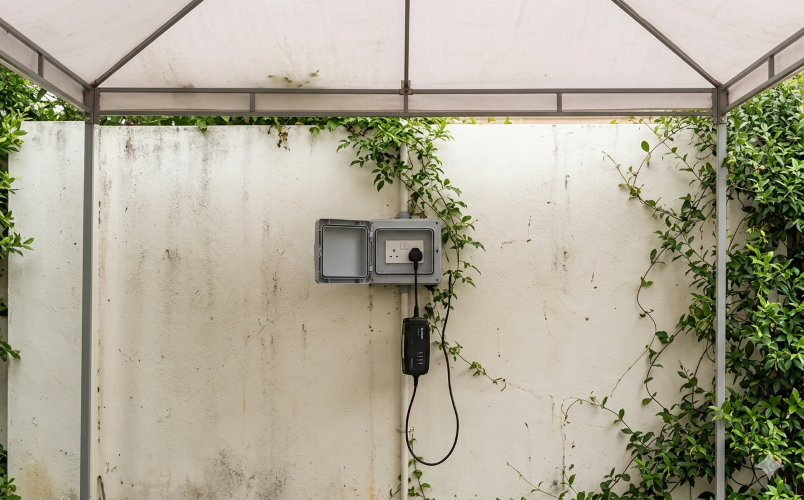
+/- R5,500. One dedicated socket in your garage or carport. Guests plug in their own portable charger overnight — enough to kill range anxiety, no charger hardware needed yet.
R8,000 – R15,000. The hard work — cable run, conduit, DB work, earthing — is already done. You’re only paying for the charger unit and Type A ELU itself.
The extension cord problem, if you do nothing
Without a dedicated option, guests bring their own extension cord and plug into the nearest socket — the fridge, the washing machine, an outdoor plug. You find out when your bill arrives R150–R300 higher than normal. Worse: a standard extension cord isn’t rated for continuous 16A overnight charging. That’s a real fire risk, not a theoretical one.
A 16A socket runs at roughly 3.3–3.7kW — plugged in at 9pm, that’s 33kWh added by 7am. More than enough for an overnight top-up, and it pays for itself the first time it’s the reason a guest chose you over the place down the road.
10 — Let’s Partner
Are you an EV dealership or sales consultant?
Your customer goes home and plugs their portable charger into a wall socket. That socket now carries 8–16 amps for 10 hours straight, on a circuit that was never designed for continuous load — often shared with the kitchen.
Most times, nothing happens. Sometimes the socket discolours. Occasionally it begins a slow, quiet burn that degrades the whole circuit.
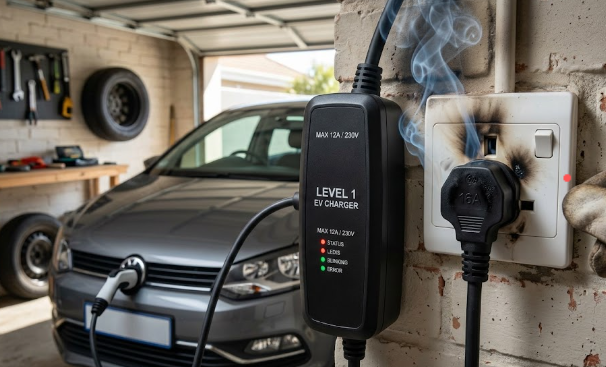
When that happens, your customer won’t phone an electrician. They’ll phone you — the person who sold them the car.
If you’re a dealership or sales consultant looking for someone to refer customers to before that phone call ever happens, that’s a conversation I’m very happy to have
Ready to find out what your board can actually handle?
Free site visit.
Straight answer in writing.
No obligation ever.
Licensed Electrician · Cape Town & the Western Cape
Each Car Offers Different Options
Yes. Jetour South Africa supplies a GridCars home wallbox charger with certain EV models. The dealership does not install the unit directly but refers customers to GridCars’ certified installer network for compliant installation. Installation costs are billed separately by the installer. While the charger may be “supplied,” installation is billed separately by the installer. WhatsApp EVCI.tech (Frankie) for a free site assessment and quote in Cape Town, Western Cape.
BYD South Africa supplies a 7 kW wallbox charger with its EVs, such as the Dolphin and Sealion. The onboard AC charger is mostly limited to 6.6 kW, so the bundled wallbox is correctly matched. Installation is usually arranged through dealer‑referred electricians, but customers are free to use any qualified and registered electrician provided they meet Department of Labour licensing requirements. Installation costs are billed separately. EVCI.tech is a Capetonian Installer, registered with DOL.
Yes. Geely South Africa supplies a free AC wallbox charger with the E2. The unit is rated up to 7.4 kW on single‑phase supply and can reach 11 kW if the property has three‑phase power. Installation is arranged through Geely’s local partners, but customers may also use any qualified and registered electrician. Installation costs are billed separately. Contact EVCI.tech (Frankie) for a free site assessment and quote.
No. As at the time of this posting, Omoda PHEVs sold in South Africa, including the C7 SHS and C9, do not come with a bundled home wallbox charger. The package centres on a public charging card for access to GridCars and partner networks. Buyers must arrange their own home charging solution. Installation can be done through any qualified and registered electrician, not only dealer referrals. EVCI.tech (Frankie) provides a free assessment and quote for compliant home charger installations in Cape Town.
Volvo South Africa dealerships supply a GridCars home wallbox charger with an installation allowance, plus a two‑year public charging voucher and three years of in‑car connectivity. Installation is usually arranged through GridCars’ certified partners, but customers may also use any qualified and registered electrician. EVCI.tech (Frankie) offers a free assessment and quote for compliant home charger installations in Cape Town.
Mercedes-Benz South Africa supplies a free EQ wallbox charger with installation included for every new EQ electric vehicle. In addition, Mercedes is rolling out a nationwide EQ public charging network in partnership with GridCars and Chargify, with EQ customers receiving discounted tariffs via the MB.CHARGE app. Customers may also use any qualified and registered electrician for installation. EVCI.tech (Frankie) offers a free assessment and quote for compliant home charger installations in Cape Town.
Yes. GWM South Africa supplies a GridCars wallbox charger with the Ora EV, matched to the car’s onboard 11 kW AC capability. Installation is usually arranged through GridCars’ certified partners, but customers may also use any qualified and registered electrician. Installation costs are billed separately. EVCI.tech (Frankie) provides a free assessment and quote for compliant home charger installations in Cape Town.
Yes. Hyundai South Africa supplies a free AC wallbox charger with its EV models, such as the Kona Electric and Ioniq 5. Installation is usually arranged through Hyundai’s dealer partners, but customers may also use any qualified and registered electrician. Installation costs are billed separately. EVCI.tech (Frankie) provides a free assessment and quote for compliant home charger installations in Cape Town.
Yes. Haval South Africa supplies a GridCars wallbox charger with the H6 PHEV, matched to its onboard 11 kW AC charging capability. Installation is usually arranged through GridCars’ certified partners, but customers may also use any qualified and registered electrician. Installation costs are billed separately. EVCI.tech (Frankie) provides a free assessment and quote for compliant home charger installations in Cape Town.
Yes. Kia South Africa supplies a free AC wallbox charger with the EV6, matched to its onboard 11 kW AC charging capability. Installation is usually arranged through Kia’s dealer partners, but customers may also use any qualified and registered electrician. Installation costs are billed separately. EVCI.tech (Frankie) provides a free assessment and quote for compliant home charger installations in Cape Town.