About EVCI – Licensed EV Charger Electrician, Cape Town
EVCI.tech · Cape Town · About
The electrician
behind every job.
One specialist. One focus. Accountable for every cable, every connection, every sign-off.

Frankie
Senior Licensed Electrician
“I install safe, compliant EV charging infrastructure for homes, guesthouses, and small businesses — and nothing else”.
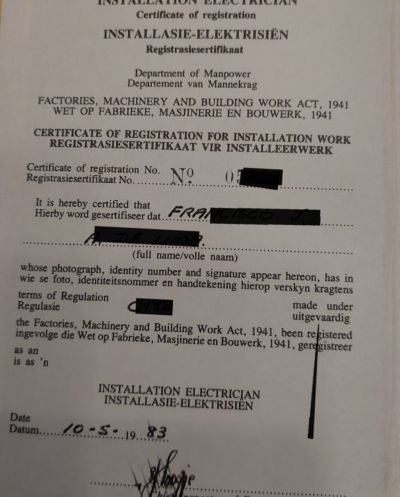
Installation Electrician Registration
–

Trade Diploma – Electrical Wiring
–

DOL Registration – Electrician
–
Any electrician can mount a charger on a wall and show you a green light. What most won’t tell you is whether your distribution board can handle a sustained 32-amp load for six hours straight — or that the portable charger from your dealership is quietly stressing your kitchen circuit every single night.
I don’t treat an EV charger like a large kettle. It’s a continuous, high-draw appliance – and the wiring behind it matters as much as the unit on the wall.
*****
Airbnb · Guesthouses · Boutique Hotels
One guest. One plugged-in EV.
One tripped main breaker.
Along the Western Cape, hosts and hoteliers are adding EV charging as a guest amenity. But unmanaged, a charger can kill your guest experience.
I design simple, load-managed, guest friendly setups that protect your property, your guests, and your reviews — without expensive infrastructure upgrades.
The load reality
Know what you’re adding to your property.
Running a 7.4kW – 22kW ‘charger’ is the electrical equivalent of switching on three geysers simultaneously — for hours. If your supply hasn’t been assessed for that load, you’re carrying real risk of circuit degradation or worse.
Where every job starts
A full power availability assessment — checking your supply capacity, DB board, existing load and unit location before a single cable is touched. The assessment is free.
Let’s start with a conversation.
No forms. No call centres. Message Frankie directly on WhatsApp and get a straight answer about your install.
WhatsApp FrankieYes – provided the installer is registered with the Dep. of Labour (DOL) as an electrician. Under SANS 10142, any heavy‑current standalone appliance must be on its own protected circuit, installed per manufacturer specs, and certified with a CoC. For EV chargers, this means a dedicated breaker, correct RCD type, and compliance with both wiring code and municipal bylaws. However, best practice is to hire someone who has done this before and understands the nuances.
An experienced electrician can install a charger wall box. The real complexity lies not in the physical wiring, but in configuring the system to work intelligently with solar generation and daylight hours. In many cases, especially in the hospitality sector, payment protocols are required — which introduces the need for familiarity with standards such as OCPP (Open Charge Point Protocol), OCPI (Open Charge Point Interface), and ISO 15118. Understanding these frameworks, along with the various payment options they enable, is where most of the additional expertise is needed.
For starters, the electrician must prove Department of Labour (DoL) registration. Ideally, they should hold the correct installation license — remember, a single‑phase electrician cannot legally sign off three‑phase work. The quote itself must specify the type of earth leakage unit (ELU), SANS requires Type A earth leakage protection under VC 8035 and SANS 556‑2 for circuits with pulsating DC, such as EV chargers. Cable sizing is critical: 6 mm² or 10 mm² depending on distance. If a quote specifies 4 mm², disqualify it immediately — it’s non‑compliant and unsafe. As an optional but recommended measure, a Type 2 surge arrestor can be included to protect the installation against transient overvoltages. A Certificate of Compliance (CoC) must be included in the quote.
At minimum, the charger must be wired and configured to take advantage of daylight hours. Charging directly from a solar battery is more complex: the electrician must coordinate with the inverter installer or system designer to set safe discharge limits. Without this step, the charger can unintentionally drain the battery during a session, leaving the household without backup power.