EVCI.tech · Cape Town · Hospitality Guide
EV Charging for
Airbnb & Guesthouse Hosts
You don’t need to install an expensive wallbox today. Here’s the smart, low-cost way to future-proof your property — and win EV guests right now.
The big picture
EVs Are Coming — Whether You’re Ready or Not
Electric Vehicles and their cousins — Plug-in Hybrids — are gradually beginning to make an impact as adoption grows in South Africa. Whilst still far from mainstream, there are over 4,000 EVs and PHEVs on South African roads today, and that number is accelerating. Many travellers are also now opting to rent EVs instead of standard combustion cars.
As a hospitality host, this matters to you. Not next year — now.
Remember when Wi-Fi was “optional” for guesthouses?
EV charging is at that same inflection point today — still nascent, but hospitality needs to adapt. The hosts who put in Wi-Fi early didn’t regret it. The ones who waited lost bookings. EV charging is following the exact same curve.
The smart approach
Start Small. Scale When Ready.
Installing a full wallbox may still feel like a big step — and that’s completely fine. You don’t need to go straight to a 7 kW wallbox. Here’s what we’d do if we were running an Airbnb or guesthouse right now:
Phase 1 · Today
Dedicated 16A Plug
R2,500 – R4,000
A single, dedicated 16-amp socket wired in your garage or carport by a licensed electrician. Guests plug in their own portable charger overnight — enough to top up their battery and eliminate range anxiety. No expensive charger hardware needed yet. Just the wiring and the socket.
Phase 2 · When Demand Grows
Upgrade to Wallbox
R8,000 – R14,000
When EV guest requests become frequent, simply add the wallbox to the existing circuit. All the hard wiring work is already done — the cable run, conduit, DB board work, earthing. You’re only adding the charger unit itself. Major cost already behind you.
The hidden problem
What Happens If You Do Nothing
Don’t be surprised if your EV guest simply helps themselves. Without a dedicated charging option, here’s what typically happens — and you won’t know about it until the utilities bill arrives.
⚡ The Extension Cord Problem
Your guest brings their own extension cord and plugs into the nearest socket — the fridge outlet, the washing machine plug, or an outdoor socket. They charge overnight. You don’t know it’s happening.
By the time your electricity bill arrives, it’s R100 – R300 higher than normal. That’s likely what just happened.
Worse: a standard 0.75 mm² extension cord is not rated for continuous 16A EV charging. Running a charger through an undersized extension overnight is a genuine fire hazard — heat builds in the cable, the socket, and the plug. It only takes one incident.
Scenario comparison
Your Options Side by Side
| Scenario | Guest experience | Your risk | Your cost |
|---|---|---|---|
| ❌ Do nothing | Guest uses extension cord or random socket | Fire hazard · Hidden electricity cost · Bad review risk | R100–R300 per stay (hidden) + potential fire liability |
| ✅ Phase 1 — 16A plug | Guest plugs in portable charger overnight · anxiety-free morning | Zero risk · Controlled, safe charging | R2,500–R4,000 once off · Pays back in 1 month |
| 🚀 Phase 2 — Wallbox | Full 7 kW charging · Smart app · Premium listing feature | Zero risk · Professional installation | R8k–R14k total (R2.5k–R4k already spent in Phase 1) |
What a 16A plug actually delivers
Overnight Top-Up — More Than Enough
A 16A socket runs at roughly 3.3–3.7 kW — the same as most portable EV chargers (Type 2 or the standard brick charger that came with the car). Plugged in at 9pm, by 7am that’s 10 hours × 3.3 kW = 33 kWh added to the battery.
Do this now — it pays for itself in under a month
A Phase 1 installation costs R2,500 – R4,000. One EV guest who would have otherwise chosen the property down the road — or left a negative review about no charging — covers that cost entirely. Then every EV booking after that is pure upside. When you eventually add the wallbox, the cable run, DB work, conduit, and earthing are already done. You’re only paying for the charger unit.
What EVCI installs in Phase 1
The 16A Dedicated Socket Installation
- Site assessment — electrician checks your DB board capacity and maps the optimal cable route to the garage or carport.
- Dedicated 16A circuit — new breaker in the DB board, sized correctly for continuous EV charge load (not shared with other appliances).
- Correct cable sizing — 2.5 mm² or 4 mm² copper, run in Bosal 25 mm conduit for full surface protection.
- Weatherproof 16A socket — IP-rated socket in the garage or carport, positioned at a convenient height for overnight plug-in.
- Proper earthing — 3-core cable with supplementary earth, ready for wallbox upgrade later without rewiring.
- Certificate of Compliance (CoC) — issued on completion. Required by your insurer and body corporate.
- Wallbox-ready — cable sizing and circuit breaker spec’d to simply bolt on a 7 kW wallbox when you’re ready, no rework needed.
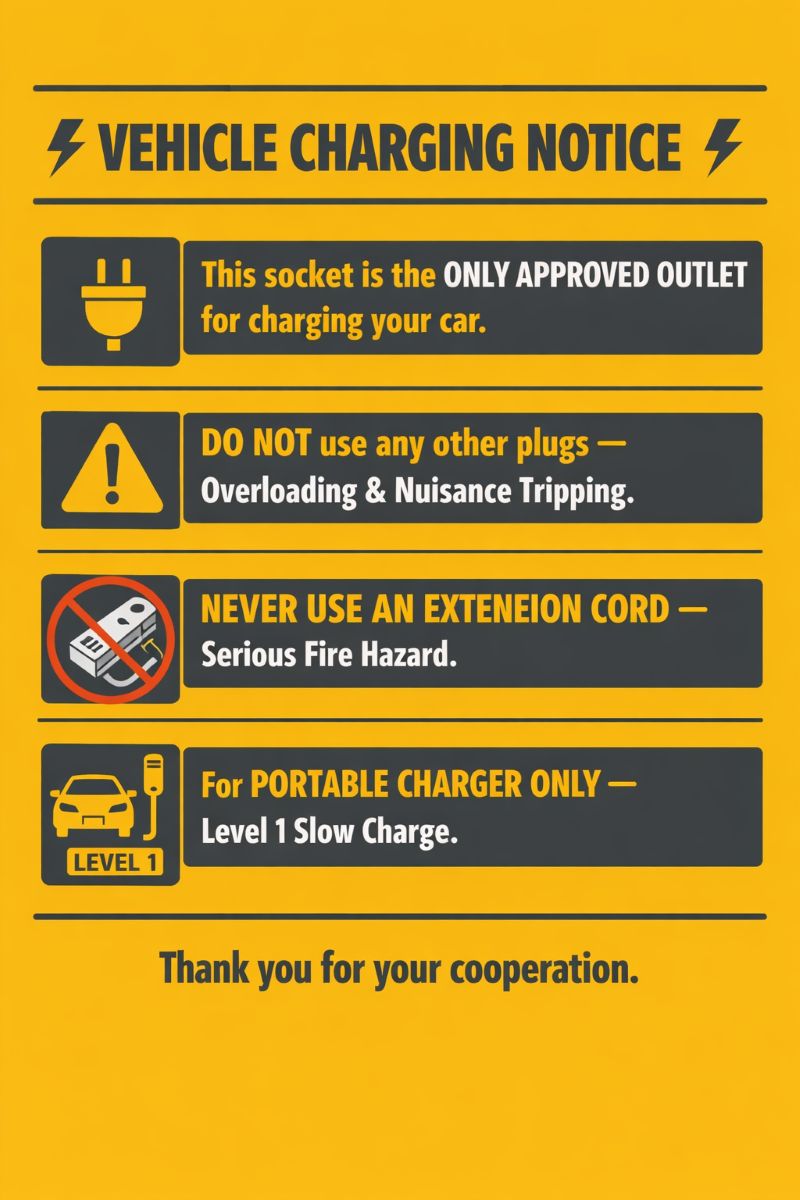
Dedicated 16A Socket Installation
Phase 2 — when you’re ready
Upgrading to a Full Wallbox
When EV guest requests become regular — or when you want to charge a premium rate for fast charging — simply call EVCI back. We mount the wallbox to the existing socket position, connect to the already-run cable and breaker, and commission it. No new cable runs, no new DB work, no new conduit.
- 7 kW wallbox — charges most EVs fully in 6–10 hours. Guests wake up to 100%.
- Smart scheduling — app-controlled charging lets you set off-peak hours (22:00–06:00) to minimise your electricity cost.
- Usage tracking — some wallboxes log kWh per session so you can charge guests accurately for electricity used.
- Premium listing status — a branded wallbox photo on your listing signals seriousness to EV drivers and commands higher nightly rates.
- Zero rework cost — because Phase 1 was spec’d for wallbox-readiness, the upgrade is straightforward and affordable.
Phase 2 — Wallbox Installed
Photo of a branded 7 kW wallbox (e.g. Wallbox Pulsar, ABB Terra) mounted in a guest garage or carport — showing the clean upgrade from a socket to a full charger.
Recommended: 800 × 500 px, landscape