Pavement charging in Cape Town
No driveway? No garage? Here’s what it would actually take to charge from the street in Sea Point, Green Point, Woodstock, Salt River or BoKaap.
 Kerbo Charge UK Inspired
Different city, different layout, different problem
Compared to Joburg’s larger stands and driveways, a lot of Cape Town’s older suburbs — Sea Point, Green Point, Woodstock, Salt River, and others — were built with on-street parking as the norm. Many properties simply don’t have room inside the boundary to park a car, let alone charge one.
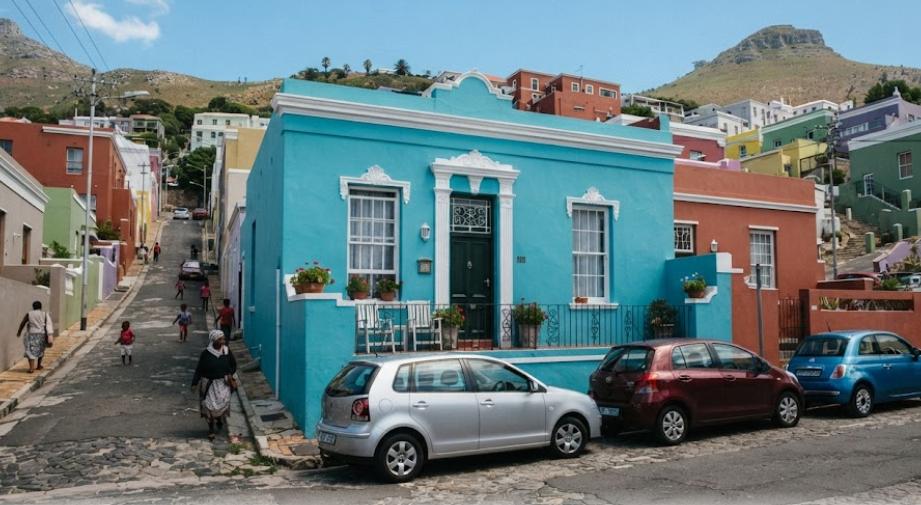 Typical street parking home in many part of Cape Town
For an EV or PHEV owner in one of these homes, that leaves public charging as the default fallback. It works, but it’s slower, more expensive per kWh, and dependent on a charger being free and working when you need it.
So — is there another way?

A robust purposely fabricated channel installed accross the pavement (with Municipal permission) could by a practical solution if adopted by Cape Town City Council
Kerbo Charge: a channel, not a cable across the pavement
A UK company called kerbo Charge has built a specific answer to this exact problem. Instead of running a cable loose across the pavement — a trip hazard, and typically not allowed — they install a slim, recessed channel from your door to the kerb. Another player in the space appears to be Gul-e
Of course, as things stand, in South Africa, street poles are not a practical solution due to high theft and grid limitations. So the in-pavement crossing channels is (to my mind) an attractive alternative.
You plug your cable in at home, feed it through the channel, and connect to your car at the kerb. The lid keeps the surface flat so pedestrians, prams and wheelchairs aren’t obstructed — and you’re not left with a cable someone can trip over.
Source: Kerbo Charge and multiple UK council EV charging pages (Slough, Enfield, West Berkshire).
The pavement isn’t yours — and that’s the whole issue
This is the part worth being blunt about: the pavement outside your house belongs to the municipality, not to you. Cape Town has by-laws governing what may and may not happen on municipal roads and public places, and running a cable — covered or not — across one without permission falls foul of that.
THIS IS AN IMPORTANT FACTOR
The liability point matters most. Even where councils in the UK do allow it, the resident remains personally liable if someone trips — because standard home insurance doesn’t extend past your property boundary. Kerbo Charge actually requires proof of public liability insurance as part of their approval process. The same principle would apply here: this isn’t just a permissions issue, it’s a personal risk issue.
So this was never a “quietly do it and see if anyone notices” situation. It needs the council’s sign-off, full stop.
Does anything like this exist here yet?
Not that I could find — there’s no current City of Cape Town programme or pilot for pavement charging channels. That said, the City’s own parking policy already references provisions for EV parking and charging facilities as a planning consideration, so the intent to accommodate EV infrastructure exists on paper, even if there’s no operational pathway yet.
Two things make this a genuinely harder sell here than in a UK town:
- 1No precedent, no process.UK councils had years of trials before rolling this out at scale. Here, someone has to be first — and that’s a slower, more manual conversation with the City.
- 2Cable and equipment theft.Copper and cable theft is a well-known problem in South Africa. Even a locked-down channel system doesn’t fully remove the risk of an unattended charging setup at the kerb — and overnight street charging specifically is a harder case to make here than in most UK suburbs.
Not a DIY project — a City conversation
I don’t think an individual homeowner applying alone would get anywhere with this. But as EVCI.tech, with a direct interest in EV adoption in the city, there’s a reasonable case for opening that conversation with the City of Cape Town — the same way UK councils were approached by residents and installers before any policy existed.
Several UK councils use a model where the local authority takes on long-term maintenance responsibility and charges a licensing fee to cover it — the resident doesn’t own the infrastructure, they hold a licence to use it. That structure is what makes liability and upkeep manageable at scale, and it’s a reasonable template to propose here rather than starting from scratch.
It’s not a universal fix
- ✕“This solves street charging for everyone.”It won’t suit every street or every household — some pavements, road layouts, or crime-risk areas simply won’t be good candidates.
- ✕“You can just install one, like a wallbox.”No — this only works with council approval, an approved contractor, and (in the UK model) proof of liability insurance.
- ✕“Overnight street charging is safe everywhere.”Given local theft risk, night-time charging at the kerb needs a harder look here than it does in a UK suburb.
It remains a genuinely tricky environment for this kind of infrastructure — administratively and practically. But “tricky” isn’t the same as “impossible,” and it’s worth the conversation.
Live in a no-driveway suburb and curious about this?
I’m exploring this with the City — if you’d want pavement charging outside your home, get in touch and be part of the conversation.
WhatsApp Frankie →Pavement charging outside your house in Cape Town
Short answer is no you can’t, unless you have explicit municipal authorization (which is unlkely). Draping loose cables or using makeshift rubber mats across public sidewalks is typically illegal due to severe pedestrian trip hazards and municipal liability risks. Don’t do it!
No you cannot! Using standard household extension cords or multi-plug cords with portable EV chargers (ICCPDs) is strongly discouraged and unsafe. If something happens – it’s on you. Plus – – – electric vehicle chargers draw high, continuous electrical loads over many hours, which can cause extension leads to overheat, melt insulation, trigger electrical failures, or spark fires.
For urban residents who rely on street parking outside terraced or high-density housing, the emerging standard could be in-pavement cable channels (such as shallow recessed metal gulleys). But note that this is currently not allowed by the Cape Town municipality. Currently, as things stand (2026/2027) public charging is the only option for EV owners with no garage, carport or dedicated space inside the property.