Sectional title EV charging in Cape Town
Shared chargers cause more disputes than they solve. Here’s a fairer way to structure it.
I’d propose a simpler, fairer alternative: individual bay charging, built on shared communal backbone infrastructure.
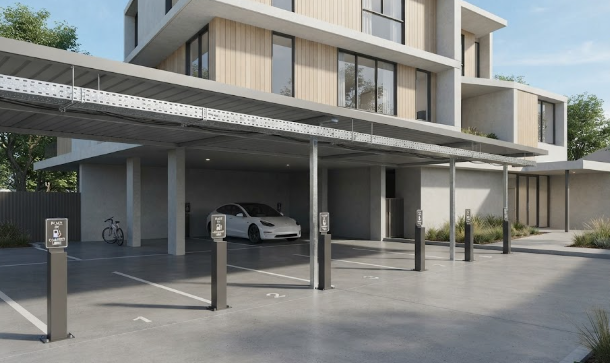 – Render Only –
Six steps: backbone infrastructure first — then individual charger ownership
The logic is simple — the body corporate pays once for shared infrastructure that makes charging possible at all – and each owner pays for their own charger on top of it. Meaning – Nobody’s fighting over a shared unit, and nobody’s carrying anyone else’s cost.
Install the communal backbone for the chargers
Trustees approve and fund the shared infrastructure that enables charging in the first place.
- Charger main board sized using a diversity factor — the assumption that not every unit charges at full power simultaneously, which keeps the shared board realistically sized instead of over-built
- Cable trays along the parking bays
- Sleeves through the pavement for neat, safe routing
- A baseline charging software platform to sit on top
Assign individual EV chargers
Each apartment owner installs and owns their own charger point (off the shared backbone).
- Cabling run from the charger board to the owner’s bay
- Wallbox purchased and owned by the individual owner
- Cost typically ranges R7,000–R20,000 depending on cable run distance — broadly in line with what individual installs cost elsewhere in South Africa, though your exact figure depends on a site survey
Control the load per unit
Prevent overconsumption and keep the shared board’s sizing math honest.
- Limit individual chargers to 3.6kW (16A) — most home wallboxes are capable of far more (32A/7kW), so this cap is a deliberate trade-off: slightly slower charging per unit, in exchange for a shared board that stays stable across dozens of units
- Breaker trips automatically if a higher draw is attempted
- Where needed, consider reducing individual apartment supply from 60A to 50A to protect overall scheme capacity — this would need a proper load assessment per complex, not a blanket rule
Implement a billing platform
Ensure transparent, automated cost recovery — nobody subsidising anyone else’s charging.
- RFID card system linked to each owner’s account
- Managed by a CPO (Charge Point Operator)
- Automated usage reconciliation, typically via OCPP-compliant hardware — the industry-standard protocol that lets different charger brands and billing platforms talk to each other
Set an inspection protocol
Mitigate fire risk and keep every installation compliant, not just the first one.
- Every individual installation needs a Certificate of Compliance (CoC) from a registered electrician before it’s switched on — this isn’t optional, and without it a resident’s home insurance can be at risk if there’s ever an electrical fire
- Annual inspection of all chargers thereafter, funded by a fixed annual fee per owner
- Installations must meet SANS 10142-1, including Annex N — the section of the code specifically covering EV charging infrastructure
 – Render Only –
Adapt for block constraints
Not every complex will fit this model exactly as described.
- Where existing supply is limited, a staged rollout may be more realistic than doing every bay at once
- Metering managed entirely by the CPO can simplify billing in some schemes
- Shared charging remains a fallback option only where the diversity-factor math genuinely doesn’t work for a particular block
The EV mobility case for trustees
- Fairness: no disputes over a shared slot, because nobody’s sharing a charger.
- Scalability: the diversity factor keeps the board stable even as more owners install chargers over time.
- Financial logic: the HOA pays once for backbone infrastructure; each owner carries their own charger cost. No cross-subsidy.
- Property value: EV charging is increasingly showing up as a selling point in listings for sectional title complexes that have it — some Cape Town estate agents are already flagging “EV charger ready” as a feature. It’s an emerging trend rather than a proven valuation premium at this stage, but the direction is clear.
- Safety: CoC on every install, annual inspections, and breaker limits keep fire and overload risk in check.
This model is clean, neat, and trustee-friendly.
The HOA invests once in backbone infrastructure, owners invest in their own chargers, and billing runs automatically. It avoids the pitfalls of shared charging while keeping costs manageable and compliance intact — and it gives trustees a proposal they can actually say yes to, backed by legislation that’s already on your side.
Note: costs, thresholds, and load figures above are general guidance — every scheme’s electrical capacity is different, and a proper site assessment should confirm the numbers for your specific complex before going to trustees.
Looking at this for your complex?
If you’re weighing up sectional title charging, I’m happy to do a high-level assessment — a starting point before you take a proposal to trustees.
WhatsApp Frankie →Sectional title EV charging in Cape Town
Mostly no, but not entirely zero. The one-off backbone installation (board, trays, sleeves) is a capital cost the HOA funds, typically from the reserve fund (or a special levy). But the ongoing electricity usage costs the scheme nothing: because each charger is sub-metered and billed via RFID/CPO to the individual owner’s own account, non-EV owners never subsidise anyone’s charging, and there’s no ongoing levy impact from usage.
The body corporate carries responsibility for the shared backbone (board sizing, cable trays, common-property wiring), while each owner is responsible for their own charger — which is exactly why the CoC and annual inspection steps aren’t optional extras, they’re what keeps that liability line clean.
Sectional title EV charging in Cape Town dictate that the charger is a fixture attached to the property – so it typically transfers with the sale rather than leaving with the seller — in practice this is usually a selling point, not a complication. The one thing that must be in order before transfer is the CoC; without a valid one, the property transfer itself can be held up, since municipalities and conveyancers check for it. Worth trustees confirming in the conduct rule that the consent to charge (not just the physical charger) also runs with the unit, so a new owner doesn’t have to reapply from scratch.