Save money
charging
your EV
Cape Town’s outdated tariff structure means timing and planning matter more than ever. Here’s exactly how to cut your EV charging bill — with real numbers.
Look at your whole
household first
Before you even plug in your new charger, it’s worth understanding where your existing electricity is going. Adding an EV to your home is a significant new load — and the easiest way to make room for it in your budget is to find savings elsewhere first.
In a typical South African household, the single biggest consumer of electricity isn’t lighting, appliances, or entertainment — it’s your geyser.
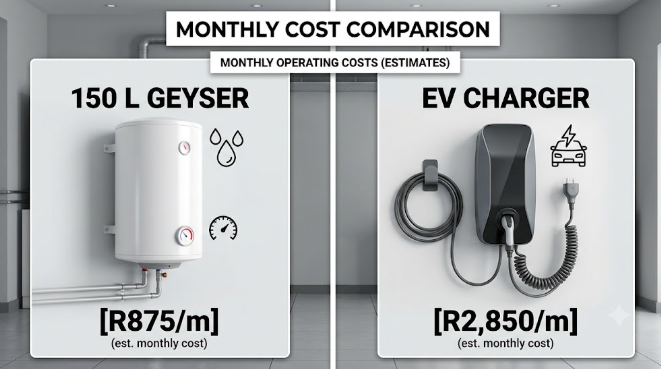
A standard 3 kW, 150 litre geyser runs for roughly 2–3 hours a day to keep up with household hot water demand. That works out to approximately 225–270 kWh per month — one of the largest single line items on your bill.
Your EV is now your
biggest appliance
A standard 7 kW home wallbox — the type usually supplied by your EV dealership — draws more than double the power of your geyser element. Charging typically takes 4 to 8 hours per session, depending on your battery size and how depleted it is.
Assuming 20 charging days a month at an average of 6 hours per session, here’s what that adds up to:
Your EV has become over 3 times more energy-hungry than your geyser — the appliance most households assume is their biggest electricity cost. This is the real number to plan around.
eating your bill
Cape Town has no
off-peak rate
In most countries with high EV adoption, utilities offer time-of-use (TOU) tariffs — cheaper electricity overnight to encourage off-peak charging. Cape Town, unfortunately, does not offer this to ordinary residential customers – – Source
Instead, the City charges a flat block tariff — the more you use in a month, the more each unit costs, regardless of what time of day you draw it. TOU pricing exists only for certain commercial and industrial accounts, not for homes.
This means an EV owner who charges freely without planning can easily push their entire household into the expensive Block 2 rate — making every kWh in the home more costly, not just the EV’s share.
Stay under
the 600 kWh line
The smart move to save money charging your EV is to budget your monthly usage so your household stays in Block 1. A reasonable split for most homes:
On a 60 kWh battery, 300 kWh of charging budget gives you roughly 5 full charges a month — translating to about 1,500–1,600 km of driving, or roughly 400–500 km a week.
For most commuters, that’s comfortably enough. With a bit of planning — charging to 80% rather than 100%, and being mindful in high-mileage weeks — staying under the 600 kWh threshold is realistic for the majority of Cape Town households.
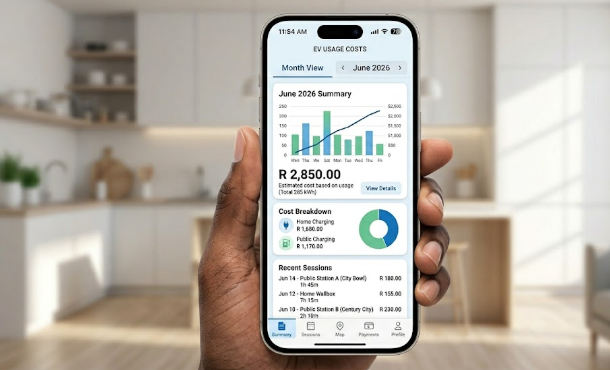
1,600 km a month in an average petrol car (around 7 L/100km) at current coastal pump prices (~R26/litre) costs roughly R2,900 in fuel.
The same distance in an EV, charged within Block 1 at R3.40/kWh, costs roughly R1,000–R1,050 in electricity.
Even if you occasionally spill into the more expensive Block 2 rate, an EV remains significantly cheaper to run than a comparable petrol vehicle either way.
Three practical
ways to save
None of these require expensive upgrades. They’re habits and small investments that compound every single month.

Hi – this is a test comment. The email address and/or URL is not required