Can any electrician
install an EV charger?
but only if they understand these five critical things.
EV charger installation isn’t complicated — but it is specific. A 7 kW charger, for example, draws continuous high current for hours. The margin for error is narrow, and the consequences of cutting corners are real.
Licensed.
But also informed.
South African SANS code is clear: any fixed electrical installation must be done by a licensed electrician – SANS 10142, and must be completed with a Certificate of Compliance (CoC). That’s the legal baseline.
But a licence alone doesn’t guarantee a good EV install. A general electrician who’s never wired a charger circuit may still leave you with an undersized cable (125% rule), the wrong protection device (type A ELU), or nuance that trips your main breaker.
Here are the five things your electrician needs to get right — and what to ask before they start.
Cable sizing
is critical
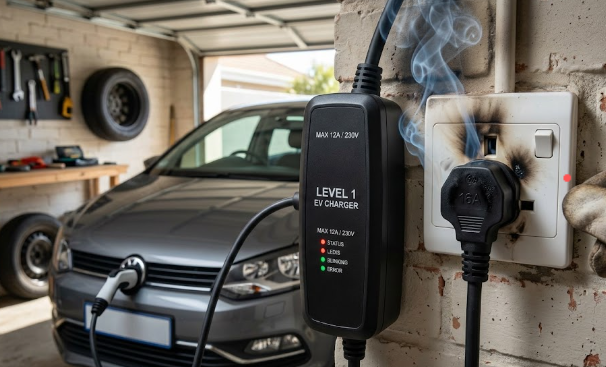
The run from your DB board to your charger carries a continuous 32A load for hours at a time. This isn’t like wiring a plug. Undersized cable generates heat, which degrades insulation, causes voltage drop, and — in worst cases — starts fires.
Cable sizing depends on the length of the run, the installation method (in conduit, surface-mounted, or buried), and ambient temperature. A quick calculation before purchase is essential — not an afterthought.
Type A ELU minimum —
sometimes Type B
An Earth Leakage Unit (ELU) — also called an RCD — is the safety device that cuts power if it detects a fault current to earth. For EV charger circuits, a standard domestic ELU is not always enough.
The reason: EV onboard chargers contain power electronics that can produce smooth DC leakage current during a fault. This DC component can blind a standard Type A device, preventing it from tripping even during a genuine shock hazard.
Earthing and bonding
must be solid
Earthing is the most important safety element of any EV charger install — and the most commonly under-engineered. A fault on a poorly earthed circuit is a serious safety risk.
Best practice is to use 3-core armoured cable from the DB to the charger, and to terminate two separate earth paths: one via the earth core of the cable, and one via the cable’s steel wire armouring (SWA). This gives you a redundant earth — if one path fails or corrodes, the other provides protection.
We always install using 3-core surfix (or armoured) cable and connect both the earth core and/or the armouring at each end. This provides two independent earth return paths and is significantly more robust than single-core earth installations.
The charger chassis and any external metalwork is then bonded to the same earth — ensuring that if a fault occurs, everything is at the same potential and the ELU trips immediately.
Load assessment
before anything else
A 7 kW charger draws 32A continuously. Before a single cable is pulled, your electrician must assess whether your supply can handle the additional load — especially in Cape Town, where most homes are on restricted single-phase supplies.
On a standard 60A single-phase supply, running a 7 kW charger alongside peak household loads can cause the main breaker to trip. Smart load management — where the charger automatically throttles between 3 kW and 7 kW based on available capacity — can solve this without needing a supply upgrade.
Solar integration
needs careful planning
More Cape Town homes now have solar PV systems — and this adds an important layer of complexity to EV charger installation that a general electrician may not have considered.
If your charger is installed without reference to your solar setup, two problems can occur. First, your EV may drain your battery bank at night instead of drawing from the grid, depleting the storage you need for load-shedding. Second, during the day, the charger may fight against your inverter’s export settings, causing inefficient energy allocation or nuisance tripping.
The charger should be connected on the grid side of your inverter in most domestic setups — so it draws from solar generation when available, and from the grid when not, without discharging your battery bank.
In some cases, this can get sophisticated – a smart charger with solar excess tracking can dynamically match charge rate to your solar generation — only drawing what the panels are producing above household consumption. This maximises free energy and protects your battery bank.
Either way, your electrician needs to understand your inverter, battery, and metering setup before deciding where to connect the charger. This is not a guess-and-go job and many times your solar installer needs to be involved.
What to ask
your electrician
Before you accept a quote, ask these five questions. A qualified, experienced EV installer will answer all of them without hesitation.