Load management
vs energy savings
Once you bolt a 7kW charger onto your DB board, “staying under 20 kWh a day” becomes a fairy tale. Here’s my honest version of how to make EV charging more affordable in Cape Town — without setting fire to your wallet or your wiring.
That 20 kWh/day
dream is dead
Let’s not sugarcoat it. The moment that wallbox goes in, your “keep the household under 20 kWh a day” target gets thrown out the window, along with any illusions about a quiet electricity bill.
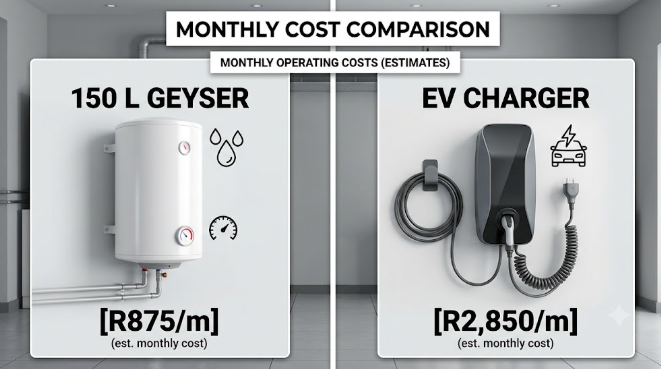
A 7kW charger running for 3 hours adds roughly 21 kWh to your day. That’s more energy than most Cape Town households use for everything else combined. At a conservative (low) R3/kWh, that’s somewhere around R63 a charge — and it climbs fast if the session runs longer.
That cost is not optional. You bought the car to drive it. The game isn’t “how do I avoid this kWh” — it’s how do I manage total load and stop wasting power everywhere else so the EV doesn’t blow your whole month’s budget.
physics. But you can manage it.
Load management:
set it and forget it
This is the bit that doesn’t need a personality transplant or a sudden love of cold showers. A CT clamp controller puts a hard ceiling on your incoming supply — say 50A — and enforces it automatically, no input required from anyone in the house.
This approach is simpler and more bulletproof than relying on a fancy EV charger’s own dynamic load-shedding feature. Why? Because it protects your whole house, not just the car. Your geyser doesn’t care that the charger is “smart” — it’ll still trip your main breaker if nobody’s watching the total load.
Energy savings:
this one needs willpower
Cutting actual kWh consumption isn’t a five-minute DB board job — it requires discipline – and admitting that the tumble dryer has been quietly bleeding you dry for years.
Here are the five big offenders.
ROI: under
one year
Here’s where it gets genuinely exciting — This isn’t a ten-year solar payback dressed up in marketing gloss. This is fast money (with minimal disruption).
TO BE CLEAR: — this isn’t an argument against solar. It’s an argument for doing the cheap, fast win first, while you save up for the expensive, slow win.
Why nobody’s
pushing this
If the maths is this good, why isn’t every electrician in Cape Town shouting about it from the rooftop (solar panel optional)? A few reasons, none of them flattering.
- Homeowners don’t see it. Invisible kWh waste doesn’t trigger the same urgency as a tripped breaker. Lifestyle inertia is a powerful, expensive thing.
- Electricians make more on solar and EV installs. Telling someone to dry-line their washing isn’t exactly a high-ticket service call — even though it’s the better advice.
- It feels like nagging. “Use less” doesn’t sell installs the way “buy this shiny thing” does. Nobody wants to be the electrician who tells you to stop using the tumble dryer.
Smart meters:
watching the rand drain
Here’s the trick that actually gets homeowners to act: stop talking in kWh, and start talking in Rand, in real time. How? Install 3–4 smart DIN-rail meters in the DB board, and suddenly the invisible becomes very, very visible.
That’s not an abstract kWh figure buried in a municipal statement three weeks later. That’s Rand, today, on a screen in the DB board cupboard. Homeowners suddenly see exactly where their prepaid tokens are disappearing to — and start asking for solutions, not the other way around.
Two jobs.
One electrician.
Load management is the easy half — a CT clamp and a controller keeps you under your supply limit, automatically, forever, with zero lifestyle changes required. Energy savings is the harder half — it needs appliance discipline and slight lifestyle adoption, but the numbers genuinely add up.
Together, the two offset your EV charging costs and deliver a payback period under a year — faster than almost anything else in this industry, solar included (I’m not bashing Solar).
Load management vs energy savings tips for EV Charger Installs in Cape Town